

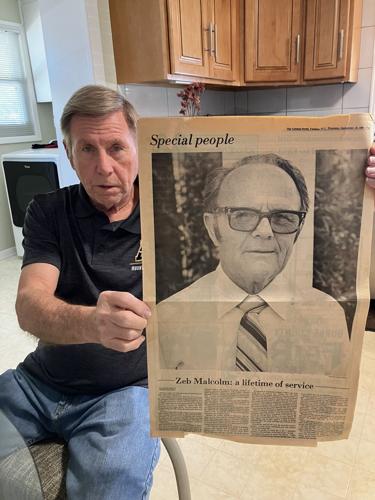


Next summer, Rutherford College will be celebrating the 50th anniversary of its reincorporation as a municipality back in 1977.
It will also be celebrating the legacy of the man who worked so hard to make that reincorporation a reality — Zeb Malcolm.
Zeb Malcolm was not a large man, as physical standards go, but he had a huge impact on his adopted home and community — Rutherford College.
Zeb Malcolm was not a native to eastern Burke County, but he grew to love the area and its people fiercely and to define it as his home.
And no, Zeb Malcolm never set out to build a personal legacy. Instead, he set out to build a town where longtime residents felt secure, newcomers felt welcome, and respect and civility were the order of the day at Town Hall.
His motto, which he used hundreds of times over the year, whether talking to a town resident with concerns or a pesky reporter was nagging questions, was always the same:
“We want everything to be as right as right can be.”
More than 35 years have passed since Zeb stepped aside from his duties as mayor of Rutherford College — duties he assumed when the town was reincorporated by an act of the N.C. General Assembly in 1977.
More than 20 years have gone by since Zeb’s death in 2001 at the age of 90.
And yet, he remains much admired, much loved, and fondly remembered in the town which, without his energy and determination, would likely be a part of Valdese today.
Darel Malcolm, one of Zeb’s two sons and himself now a member of the Rutherford College Town Council, is the keeper of his father’s legacy.
Sitting at the kitchen table in the house on Malcolm Boulevard which his dad owned and in which he grew up, Darel leafs through stacks of newspaper clippings, photos, certificates, and other memorabilia as he talks about his dad’s life and contributions.
“The thing I remember best about Dad, and the thing I admire most about him,” Darel says, “is that he always persevered. He wasn’t one to give up. He was the man behind this town.”
A CHILDHOOD INTERRUPTED
Zeb entered this world on Feb. 5, 1911, in the tiny, unincorporated community of Oswalt in Iredell County. Zeb’s father and mother, William and Lottie Malcolm, were farmers in early years of the century.
In 1924, Zeb’s dad decided the return on farming did not justify the long hours of back-breaking labor and he moved Zeb and his eight siblings to the nearby town of Mooresville and went to work in a textile mill.
The new circumstances did not last long. William was badly injured in an accident at the textile mill and died a few days later. Lottie was left a widow with nine children, and she faced a painful choice.
“My grandmother knew there was no way she could support nine children on her own,” Darel said. “She made the decision to send Zeb and his twin brother Zell, and brothers Jim and J.D., to the Children’s Home in Winston-Salem.
“It had to be hard on Dad,” Darel continued, “to be taken away from his home and his mother like that. But he understood why it had to be done, and I never heard him say one hard thing about my grandmother for doing what she had to do.”
The Children’s Home was a historic orphanage founded in 1909 by the Western Conference of the United Methodist Church. Located at 1001 Reynolda Road, it featured a 212-acre campus known for its cottages, school, chapel, and a large working farm.
Zeb remained at the Children’s Home for five years and he and his twin Zell developed quite the reputation as student athletes during that time, excelling at both baseball and football.
Though he weighed scarcely 120 pounds, Zeb was quite the running back, possessing blinding speed and dynamic agility. He was captain of the football team for three years and once scored five touchdowns in one game.
Although his success as an athlete made his time at the orphanage brighter, Darel said his dad “felt lost at times. It was a tough place. Lots of rules and regulations. But all in all, I think it served to make him a better, stronger person.”
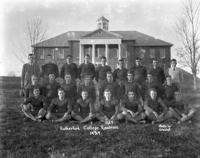
And it was that strong young man who in 1930 was offered a “working scholarship” by the small Methodist school of Rutherford College to come and play running back for the school’s football team, the Ramblers.
COMING WEST
Rutherford College had been established by the Methodist Church in 1900, primarily as a training ground for young men who wanted to be Methodist ministers.
“Dad had never heard of Rutherford College, and he didn’t know what a ‘working scholarship’ was,” said Darel. “But he knew he had a chance to play football.”
Zeb certainly did not own a car and bus service was iffy at best as the Great Depression tightened its grip on North Carolina’s economy, so the young man did what he had to do.
“He stuck out his thumb,” said Darel. “He stuck out his thumb — headed west. Luckily a kind gentleman picked him up in Winston-Salem who knew where Rutherford College was and dropped him off on campus.”
Zeb soon learned that Rutherford College was a small, tight-knit community of young people looking to better themselves through a college education. He also learned that the “working” part of his scholarship meant being responsible for the tiny school’s herd of dairy cattle.”
“He was up at 4:30 every morning to milk and feed and water the cows,” Darel said. “Then it was a quick shower and off to class. It certainly wasn’t an easy life.”
But as he continued at the school for nearly three years, Zeb developed a love for his school, his classmates, and the small surrounding community that supported them all.
“It was kinda like Dad never had a home when he was growing up,” Darel said. “But he found that home here. This became his special place. The place that he wanted to be.”
The economic realities of the Great Depression prematurely ended Zeb’s time at Rutherford College. The Methodist Church decided to merge Rutherford College and Weaver College into Brevard College in Brevard.
Soon thereafter, the town of Rutherford College was dissolved. Both the school and the municipality faded into memory.
MAKING A LIVING
His college career abruptly ended, Zeb now had to make a living.
Darel’s dad continued to play semi-pro baseball and football for industrial teams in Valdese, Mooresville, and Drexel.
Hopes for a football scholarship to continue his education at Appalachian State Teachers College were ended with a beaning in a semi-pro baseball game which left him unconscious for three days afterward.
“Dad tried a number of things soon after Rutherford College closed,” Darel said. “He worked in a textile mill in Valdese, was a fireman and an auxiliary policeman in Valdese, and was a short-order cook.”
It was after Army service during World War II that Zeb found his true calling — working as a salesman.
“It suited Dad’s personality,” said Darel. “He was very friendly. He made connections easily. He was very detail-oriented. He made sure his customers were happy, and he never made mistakes.”
Following his marriage to Marene Propst at Abernethy Memorial Church, Zeb worked first for General Mills in Detroit and then for 21 years with the Carnation Company, headquartered in Kansas City, Mo.
“Most weeks, he would leave on Monday morning and come home on Friday,” Darel said. “He saw a lot of places, and he met a lot of people. But he would always tell me, ‘Son, there’s no place better than Rutherford College.”
REVIVING A TOWN
As he neared retirement age in the mid-1970s, Zeb began to dream of a reborn Rutherford College.
He feared, Darel said, an involuntary annexation of the area by neighboring

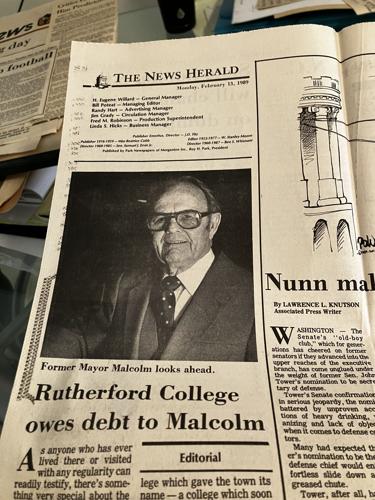
The News Herald celebrated retiring Rutherford College Mayor Zeb Malcolm with an editiorial back in 1989 praising his leadership and vision. The editorial was written by The Paper’s Editor Emeritus, Bill Poteat.
BILL POTEAT / THE PAPERValdese, and more importantly, he feared the loss of identity of the community that had supported him and nurtured him as a youth.
“He believed we have something special here in Rutherford College,” Darel said. “And it was really important to him that we maintain that special atmosphere for young families and for new residents.”
Zeb began talking to Bill Lachot, Burke County’s representative in the N.C. House of Representatives, who had grown up in Burke County.
Zeb also sought out the counsel of U.S. Sen. B. Everett Jordan, who had earlier graduated from Rutherford College and with whom Zeb had maintained a friendship over the years.
“Dad knew a lot of people, and he made a lot of trips to Raleigh, arguing that Rutherford College should be reincorporated. As time passed, people began to listen.”
Nor did Zeb take on the task of reincorporation by himself. He sought out the guidance and received the support of community leaders such as Joe Jacumin, Claude Icard Jr., Jimmy Huffman, Richard Jenson, J.T. Kincaid, and Robert W. Bigham.
In July of 1977, the General Assembly passed legislation reincorporating the municipality after more than four decades of dormancy.
“Dad was ecstatic,” Darel remembers. “He was a visionary. So much he wanted to do for this little town. A water corporation. Streetlights. Sidewalks. Whatever could be done to improve the quality of life for our people.”
The reincorporation legislation named Zeb as mayor until an election could be held. When that election came in November of 1977, he was elected to the first of three four-year terms in the town’s highest office.
SUMMING UP
What had been Connelly Springs Road, which basically serves as Rutherford College’s Main Street, was renamed in Zeb’s honor. His photo hangs in a place of honor in Town Hall. And his memory stays strong in the heart of his son.
“I’m exceptionally proud of my father,” said Darel, perhaps stating the obvious. “He was a great man. Despite a rough start, he carved out an impressive business career, he brought his town that he loved back to life, and he was a great dad.”
This story cannot be ended without a final story from Darel about his dad — a story which he believes shows how fearless his father could be.
“Dad was a great swimmer and a great diver,” Darel said. “And he used to go down and climb up on the trestle at the old Cassel Bridge, so he was 18 feet above the Catawba River, and the water was 40-feet deep.
“Dad would dive off the top of that bridge, hit the water, disappear for several seconds, and then resurface with a big ol’ clump of Catawba River mud in his hand.
“That was him in a nutshell,” Darel concluded. “Tough. Scrappy. Willing to fight for what he believed in.”
And so, as Rutherford College looks ahead to celebrating the 50th anniversary of its rebirth, it does so standing firmly on the shoulders of the man who refused to let it fade away.
Zeb Malcolm did not just help restore a town’s charter; he restored its sense of place, its pride, and its future.
In the end, perhaps that clump of river mud says it best — he was willing to dive deep, take risks, and come back up holding something solid for others to build on.



















(1) comment
Bill:
Thank you for this great tribute to Zeb Malcolm. He's high on my list of most unforgettable characters.
I was the Eastern Burke reporter for The News Herald in 1977 when Rutherford College citizens were embroiled in a contentious debate about incorporation. Mayor Malcolm was leading the incorporation effort, but not everyone was excited about the prospect of possibly paying more property taxes.
My reporting on the issue ruffled quite a few feathers. So, when the next town festival came around and candidates were considered for the honor of sitting in the dunking tank, I was high on the invitation list.
I accepted the invitation and showed up for that Saturday festival in a suit and tie to the further delight my "supporters." Being over 6 feet tall, I mistakenly assumed when a lucky throw hit the target and the seat fell I could land on my feet and stay dry above the waist.
Boy was that wrong. The first time, and every time, a baseball hit the target my tail hit the bottom of the tank. And what I assumed would be clear water in the tank turned out to be a rust-colored thick soup, because the tank had been filled from a fire truck.
To make matters worse, teenagers coordinating the long line of eager throwers decided that some of the younger kids who couldn't hit the target should be allowed to run up and hit it with their hands so they, too, could dunk the reporter.
I survived my first (and last) time in a dunking tank, made some new friends and added the experience to a long list of happy memories of Mayor Malcom, a man who I admired greatly at the time and have always remembered for his love for and dedication to making "Rutherford College as right as right can be."
I love The Paper. Keep up the good work.
Ted Hall,
Belmont, NC
Welcome to the discussion.
Log In
Keep it Clean. Please avoid obscene, vulgar, lewd, racist or sexually-oriented language.
PLEASE TURN OFF YOUR CAPS LOCK.
Don't Threaten. Threats of harming another person will not be tolerated.
Be Truthful. Don't knowingly lie about anyone or anything.
Be Nice. No racism, sexism or any sort of -ism that is degrading to another person.
Be Proactive. Use the 'Report' link on each comment to let us know of abusive posts.
Share with Us. We'd love to hear eyewitness accounts, the history behind an article.